
In short
Managing production orders in China comes down to five controls between the purchase order and the shipment: a specification signed by the factory, a bilingual contract that makes quality and deadlines enforceable, payment terms that hold back money until the goods pass inspection, active production follow-up, and complete, consistent shipping documents. For large or recurring orders, the most common structure is a deposit at order (often 30%) and a balance paid only after a passed pre-shipment inspection. Most delays and defects can be traced back to vague specifications and to buyers who only react at the end of production. Asiaction, a French-managed purchasing office in Guangzhou working with Chinese factories since 2008, runs this whole cycle for B2B buyers and reports each step in an online client portal.
This guide explains how we approach managing production orders in China, based on what our Guangzhou team sees in factories every week. Since 2008, Asiaction has handled more than 3,200 projects and works with over 6,500 partner factories. Here is where orders go wrong and which checks really protect your money and your designs on large, recurring and project orders. For the wider import process, see our guide to importing from China.
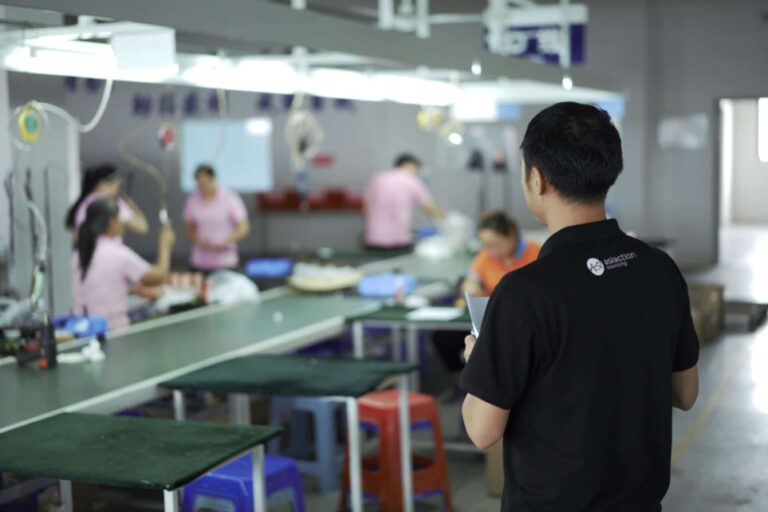
Managing production orders in China: what we see in factories
Scams exist, but they are rare. Most problems our clients face come from specifications and product quality. Four realities explain most of them:
- Factories are focused on cost and margin. If a price looks like a great deal, be careful. The factory will often find a way to keep its margin: a raw material changed where it does not show, cheaper accessories, or fewer people on your order.
- Good factories make mistakes too. Even in a serious factory, employees can get a colour, a date or a detail wrong. Wrong colours and paint spots are typical surprises on arrival.
- Quality is not universal. The same factory makes similar goods for Russia, South America, North America, Europe and India, each with different quality standards. Do not assume it will match yours without a clear explanation.
- Trust is not a control. We still meet experienced buyers who order without a background check or an inspection, relying on instinct or on a long relationship. In our experience, you are never fully protected when you order from China.
So every order we manage goes through the same checkpoints, whatever the supplier’s reputation.
Before the purchase order: lock the specifications
Chinese factories produce what is written, not what the buyer had in mind. Getting 100% of the product details on paper is the first protection. Before a large PO, fix and approve:
- Specification sheet: materials, dimensions and tolerances, finishes, colour references (Pantone, RAL), functions, with a version number.
- Golden sample: the approved sample, signed and sealed, kept in at least two copies (one at the factory, one with you or your agent). It is the reference for inspection.
- Packaging and compliance: cartons, marks, labels and manuals in the destination language, plus the certificates your market requires (CE marking in Europe, for example). Check that certificates are genuine and cover the exact product and factory. If needed, test in an accredited laboratory such as SGS, Intertek or Bureau Veritas.
- Supplier identity: the company you sign with, the factory that produces and the bank account you pay must match. A supplier verification or factory audit is the cheapest insurance before a large deposit.
Questions to answer before you pay the deposit
- Does the supplier have a real factory? Did it give you a factory address, or only an office address?
- Is everything on the proforma invoice: product details, quality level, production dates, Incoterm, payment terms?
- Will it share photos of the production line and accept a third-party inspection?
- What happens, in writing, if the goods are defective?
Settle these before production starts, ideally before the deposit.
The purchase contract: what a PO with a Chinese factory must include
For a large order, a proforma invoice alone is rarely enough. It confirms price and quantity, not what happens if goods are late or defective. Chinese companies take a document seriously when it is signed and stamped with the company chop. A contract in Chinese and English, under Chinese law, with disputes handled in China, is far easier to enforce against a Chinese factory.
| Clause | What to specify | Why it matters |
|---|---|---|
| Parties and signature | Registered Chinese company name, signatory, company chop, bank account in the same name | Prevents payments to a third party or an offshore company |
| Product and quality | Specification sheet (version), golden sample, AQL levels (ISO 2859-1), access for your inspector | Lets you refuse a batch on objective grounds |
| Delivery, penalties, remedies | Loading date, capped penalty per week of delay, rework or re-inspection at the factory’s cost | Gives you leverage when production slips |
| Incoterm and payment | Incoterm 2020 and named place, amount and trigger for each payment | Defines who carries the risk and links money to milestones |
| Tooling, moulds and IP | Moulds paid by the buyer remain its property, no use of your designs for other customers | Protects your investment and your product |
| Law and language | Chinese law, venue in China, Chinese and English versions | Makes the contract enforceable against the factory |
The Incoterm also decides who chooses the forwarder. Our complete guide to Incoterms 2020 explains each rule.
Securing orders and payments
The usual arrangement is a bank transfer (T/T) in two parts: a deposit at order confirmation, often 30%, and the 70% balance before shipment. Paying the balance against a copy of the bill of lading protects you more, but new suppliers rarely accept it. A letter of credit pays against documents, not quality: require your inspection certificate among them.
When Asiaction manages payments for a client, all payments to the factory (deposit and balance) go through Asiaction. The balance is released only after a satisfactory end-of-production inspection. Whoever pays, check that the beneficiary account belongs to the company in the contract, and confirm any “new bank details” email by phone with a known contact.
Warning signs we have seen
- A deposit far below the usual 30%, such as 10% on a large order.
- A company registered offshore (in one case, the Marshall Islands), where no Chinese court can help you.
- A refusal of any audit, or no factory name and address.
- Only a mobile number, a website less than a year old, a Chinese name missing from the official registers.
- Vague answers, “lack of resources”, or a company flagged in official Chinese records.
In our metal fastener case study, a French manufacturer had paid a $60,000 deposit on a $600,000 order to a seller registered in the Marshall Islands. We spotted it while preparing a routine inspection, before the balance was paid. In our melamine plywood case study, an importer had waited a year for panels it had paid for. The supplier was listed as defective in official Chinese records. A check before ordering could have saved the $7,266 lost.
Protecting your designs and IP with Chinese factories
Copying cannot be stopped completely in China: when one factory is stopped, another can take over. You can make it harder and hold rights you can use.
- Sign an NNN agreement (non-disclosure, non-use, non-circumvention) for custom products, in Chinese and under Chinese law. A standard Western NDA is poorly suited to China. Our bilingual NNN template also states that drawings, prototypes and moulds developed from the buyer’s information remain the buyer’s property.
- Register your IP in China. IP rights are territorial: a trademark registered in Europe is not protected in China, and China is first-to-file. Register early, including a Chinese-character version of your trademark. The EU China IP SME Helpdesk gives first-line advice on trademarks, designs and patents.
- Protect your selling markets too. Register your IP where you sell. Copies are often easier to stop where they are sold than where they are made.
- If copies appear in China, a specialised local firm can investigate the factories involved and alert the authorities.
For filings and disputes, work with an IP attorney who knows China.
Production follow-up: from pre-production to final inspection
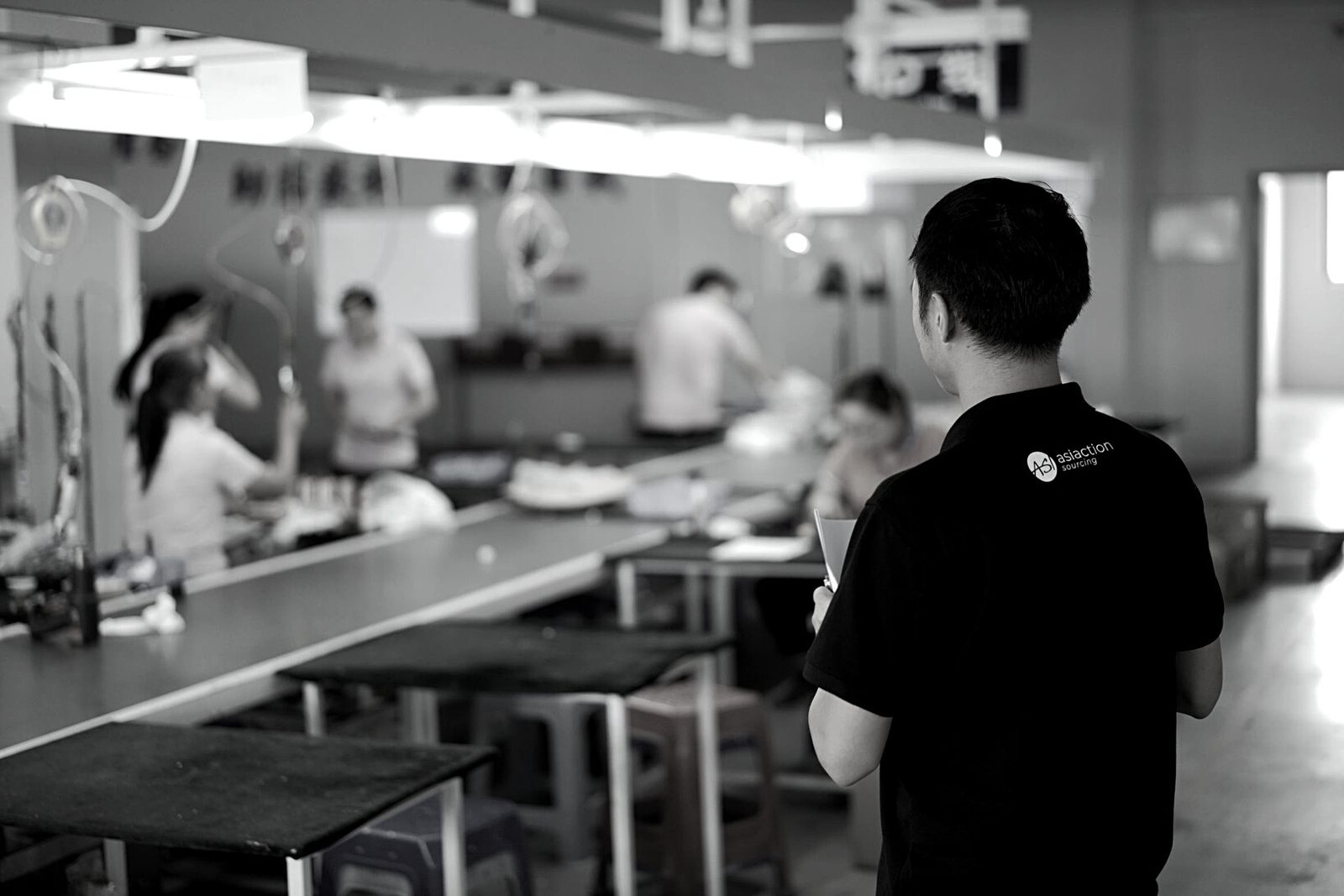
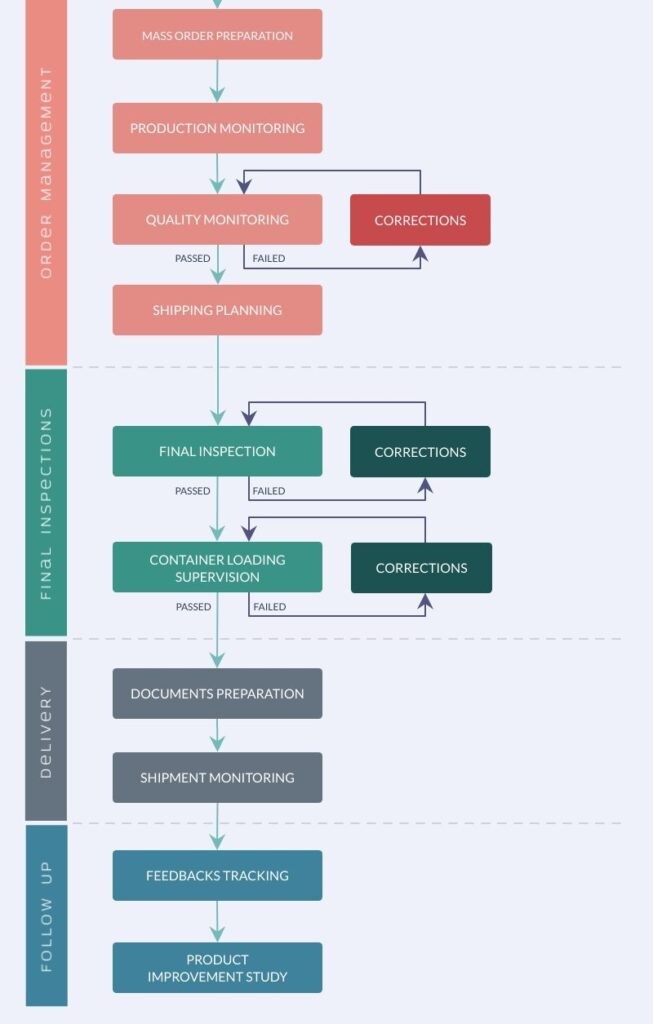
Factories rarely announce a delay early, and a defect found on packed goods costs far more to fix. Ask for a dated schedule (raw materials, production start, end of production, inspection, loading), updated at least weekly with photos or videos of the line. Then inspect at the right moments:
- Pre-production check: raw materials, components and first pieces against the golden sample.
- During-production inspection (DUPRO): catches recurring defects while they can still be fixed.
- Final random inspection (FRI): production finished, most goods packed, sampling to ISO 2859-1 (AQL).
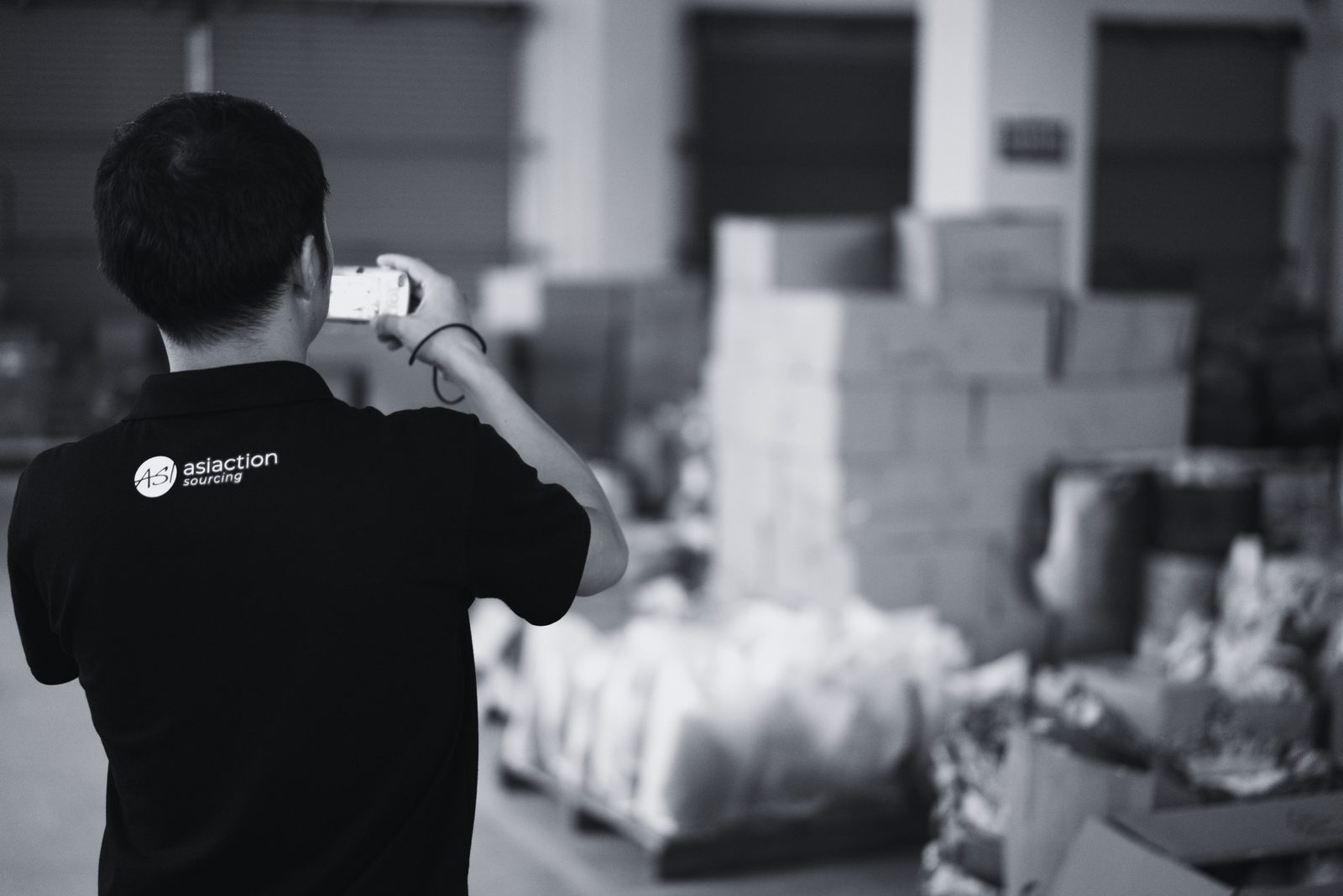
- Loading supervision: carton count, random opening, container condition and sealing. Details on our product inspection page.
Plan around Chinese New Year and Golden Week
Chinese New Year falls in January or February. Factories slow down about 15 days before and after the official week off, and shipping space gets scarce and expensive. Start planning about four months before and order about three months before, as explained in our article on ordering before Chinese New Year. The National Day holiday in early October also stops many factories for several days.
Handling delays and quality issues
A delay found at the raw material stage can often be recovered; found on the loading date, rarely. Find the cause (missing materials, lack of capacity, another customer first, hidden subcontracting), apply the contract and never accept “we will fix it on the next order” without a signed commitment. Keep control of logistics too: a factory that picks its own forwarder adds a risk you cannot see.
In our electric bike case study, the forwarders chosen by the supplier proved unreliable and the container was left in a transit country. Asiaction rebuilt the transport with a new forwarder and recovered the import documents. The goods arrived, but extra costs raised the order from €142,144 to €199,835, and delivery went from 7 to 13 weeks.
Recurring orders: the five supplier KPIs we track
For recurring orders, each order should be more predictable than the last. That takes numbers, not impressions. We tracked supplier performance internally for years before adding these five indicators to the client portal, at no extra cost:
| KPI | How we measure it | What it tells you |
|---|---|---|
| Lead time | Days from order placement to end of production | Production efficiency |
| On-time delivery | Days late or early against the promised date (negative means early) | Reliability. Early can disrupt your stock planning too |
| Non-conformity rate | % of products that work but do not match the order: wrong colour, wrong dimensions | How precisely the factory follows your specifications |
| Defect rate | % of products with a technical or functional defect: a device that will not switch on, a badly sewn seam | Quality control. A low rate can reduce your inspection costs |
| Return rate | % of products with problems in transport or after use, out of the total ordered | End-customer satisfaction |
Documents to check at shipment
Inconsistent documents cause customs delays and storage charges. Before the bill of lading is released, check that the commercial invoice and packing list match (descriptions, quantities, weights, HS codes), and that you have the bill of lading or air waybill, the certificate of origin if needed, test reports, inspection and loading reports, and ISPM 15 evidence for wooden packaging.
How Asiaction manages large orders in China
Asiaction is a French-managed purchasing office in China, in business since 2008 (Asiaction Limited was registered in Hong Kong in 2010), with its operating office in Guangzhou. Our order management service acts as your dedicated buying office, with no hidden commissions and no dependence on factories. Each client has a project manager who talks to suppliers in Chinese.
- Preparation: specifications signed by the supplier, contract in Chinese and English drafted by a Chinese lawyer, authentication of certificates.
- Follow-up and quality: daily contact with the factory, AQL inspections with PDF reports, HD photos and videos, optional tests with partner laboratories (SGS, Intertek, Bureau Veritas).
- Payments: Asiaction can manage payments for you. All payments to the factory (deposit and balance) then go through Asiaction, and the balance is released only after a satisfactory end-of-production inspection.
- Loading and shipping: loading supervision, quotes from several forwarders, export and import documents, consolidation in Guangzhou if required. See our shipping management service.
- After-sales: analysis of defects found after receipt, dialogue with the factory and an action plan (replacement, compensation or re-production).
You follow everything in the Asiaction client portal: production status and ETA, inspection reports, invoices, container tracking and supplier performance graphs, with an email at each key production event. A Caribbean home furnishings retailer, for example, started with inspections and now entrusts us with order management and shipping, as told in this furniture import case study.
FAQ: managing production orders in China
What payment terms are usual with Chinese factories?
Most often a 30% deposit by bank transfer at order confirmation and a 70% balance before shipment. Always pay the balance after a passed final inspection. A deposit far below 30% is unusual and worth a closer look.
Is a proforma invoice enough as a contract?
Not for large or custom orders. A proforma confirms price and quantity. Use a bilingual contract under Chinese law that sets penalties, inspection rights, remedies and tooling ownership.
How many inspections does a large order need?
At least a final random inspection before the balance is paid. For large, new or technical orders, add a pre-production check, a during-production inspection and loading supervision. For proven suppliers, adjust the plan to their defect and non-conformity rates.
How can I stop a Chinese factory from copying my product?
You cannot rule it out entirely, but you can make it much harder. Sign an NNN agreement in Chinese under Chinese law, register your trademark (including a Chinese-character version) and designs in China early, since China is first-to-file, and protect the markets where you sell. In the contract, state that moulds you pay for remain yours and cannot be used for other customers.
Which KPIs show if a Chinese supplier is reliable?
We track five: lead time, on-time delivery, non-conformity rate, defect rate and return rate. Followed order after order, they show whether a supplier is improving or slipping, and where to focus inspections.
Can Asiaction manage orders with suppliers I already work with?
Yes, Asiaction can help with suppliers you already work with. It starts with an investigation of the supplier (company verification and, if needed, a factory audit) before taking over the order follow-up. The scope (inspection only, full order management, shipping) is then defined case by case.
Planning a large or recurring order in China?
Our Guangzhou team prepares your contracts, follows production, inspects the goods and organises shipping, with every step visible in your client portal.