In short
To find a reliable factory in China, write a clear specification, send the same request to several candidates, shortlist a few, and check each one before paying anything: legal identity in the official Chinese register, real manufacturing activity, capacity, certificates and quality controls, ideally with an on-site audit. Then come samples, negotiation and a first order inspected before shipment. Buying direct works if you already have audited suppliers and staff who visit China; a trading company hides who really produces. For large, recurring or project orders, a purchasing office in China does this work on site for you. Choose one that is registered, present in China, shares supplier contacts and takes no commission from suppliers.
This sourcing in China guide is not theory. It sums up what our team has learned since 2008 from its office in Guangzhou: more than 3,200 projects and a network of more than 6,500 partner factories. It is written for companies that buy in volume (industrial firms, retailers, importers, brands and project companies) and want factories that deliver the right quality, order after order.
Buy direct, use a trading company or a purchasing office?
Alibaba, Made-in-China and the Canton Fair in Guangzhou are good places to start. But a listing or a booth shows how a company presents itself, not who it is legally or where your goods will be made. Many sellers there are trading companies, and many good factories are not listed online at all.
| Criterion | Direct from a factory | Through a trading company | Through a purchasing office in China |
|---|---|---|---|
| Who you deal with | The manufacturer itself | A reseller; the real factory is often not named | A team on site working for you; the factory is named and you get its contacts |
| Who checks quality | You, from abroad | The trader, who also sells to you | Inspectors in the factory, reporting to you |
| Price | Factory price, but you carry all the risk | Factory price plus a margin you do not see | Factory price plus a fee paid by you, not by the supplier |
| Works best when | You already have audited suppliers and staff who speak Chinese and travel | You accept little visibility on who produces | Large, custom, technical or recurring orders, or a team with no one in China |
A purchasing office is most useful in four situations:
- New suppliers needed: a new product, a second source, or a factory to replace.
- Technical products: building materials, metals or machinery need follow-up until the container is sealed.
- Moving purchases to China: you import from another country and want to compare.
- Existing suppliers out of control: slow answers, misunderstandings, quality you cannot check. A Caribbean furniture retailer first asked us for one inspection; we now manage several of its orders and its shipping (read the case).
Our advice: do not come to China only for the lowest price. When a buyer pushes the price too low, the factory saves on raw materials or skips steps, and quality problems start there. Part of our job is to tell you what a price cut really means.
Sourcing in China guide: how to find good suppliers
- Write the specification. Materials, dimensions, drawings or a sample, standards, packaging, volumes, target price, Incoterm, dates. In English and, if possible, Chinese. Factories fill every gap with their own choice, and changing specifications are a top cause of delays and extra cost.
- Build a long list. Platforms, fairs, industrial clusters, Chinese-language directories and existing networks. At this stage you map the market; you do not choose yet.
- Send the same request to everyone. Same specification, same questions: price, MOQ, lead time, payment terms, tooling, certificates. How fast and how precisely a supplier answers already tells you something.
- Shortlist. Remove the wrong specialisation, missing certificates, MOQs that do not fit and prices out of line with the market. In a sourcing study, our team contacts many more factories than it keeps, because many do not pass our checks. We shortlist three to five suppliers, more when the market allows, that meet your price, quality and lead-time requirements.
- Check each one, then audit. See the checklist below. Do it before any payment: once the deposit is paid, it is too late.
- Samples. Made to your specification, not from the catalogue. The approved sample becomes the quality standard for production.
- Negotiate the terms, not just the price. Payment milestones, lead time, quality level, inspection rights, penalties and the Incoterm (see our Incoterms 2020 guide).
- First order under control. Inspect before shipment and pay the balance only when the inspection is passed. Then keep checking: a good first order does not guarantee the next ones.
On a first call, five questions give a quick picture: Are you a manufacturer or a trading company? How long have you made this product? What is your MOQ? What are your lead times? What are your payment terms? A catalogue with many unrelated products usually means a trader. These answers are a filter, not a verification.
How to check a Chinese factory
One question matters: can this company deliver your product, at your volume and quality, for as long as you need it? Documents are the start; for significant orders, an on-site supplier audit gives the answer.
| What to check | How | Why it matters |
|---|---|---|
| Legal identity | Chinese name, business licence and 18-character Unified Social Credit Code, checked in the official National Enterprise Credit Information Publicity System | The English name has no legal value; you contract with the Chinese registered entity |
| Factory or trader | Business scope on the licence, factory address, premises and machines, site visit | You need to know who really produces and controls quality |
| Legal and financial health | Registered capital, shareholders, lawsuits, abnormal-operation listings | A supplier in difficulty may not deliver or refund |
| Specialisation and capacity | Main products, years on this product, production lines, capacity, export markets | A factory that is not specialised, or already full, will subcontract or be late |
| Certificates | ISO 9001, product certificates and test reports, confirmed with the issuing body | Copies are often borrowed, expired or issued for another product |
| Quality system | Incoming, in-process and final controls, seen during the audit | This is what keeps quality stable from one order to the next |

What we see in Chinese factories
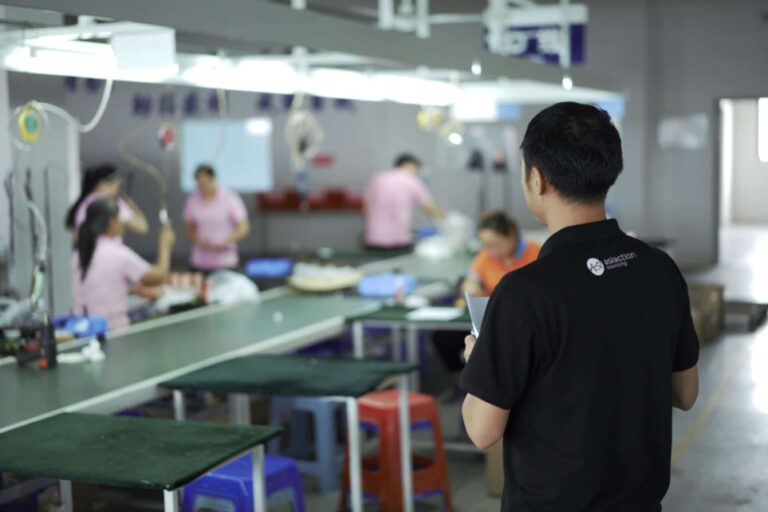
- The factory you visit is not always the one that produces. Some suppliers show one site and make the goods elsewhere.
- Certificates need checking. We confirm them with the issuing body, and we work with labs such as SGS, Intertek and Bureau Veritas when tests are needed.
- “Cha bu duo”, “almost the same”. Some factories adapt your standard to what their machines can do, without telling you.
- Hidden subcontracting. Part of the work can go to a less careful workshop.
- Perfect samples, different production. A good sample wins the order; mass production does not always follow.
- Quality can drop at any order. That is why we inspect every production we follow, not just the first one.
Red flags that should stop the deal
- The bank account is not in the name of the company on the contract, or belongs to an offshore entity.
- English name, Chinese name, province or address differ between documents.
- The supplier refuses or keeps postponing an audit, or will not name the real manufacturer.
- Prices far below the market, or a deposit so low it looks like bait.
- A request for full payment before production, or bank details that change at the last minute. The usual practice is 30 to 50% at order and the balance at the end of production, before loading.
Two real cases. In the metal fastener case, a French manufacturer had paid a $60,000 deposit on a $600,000 steel order to a company claiming to belong to a major Chinese steel group. Our checks found an entity registered in the Marshall Islands, Chinese and English names that did not match, and a refusal to be audited, before the balance was paid. In the melamine plywood case, an importer that had ordered without any local check waited about a year for its goods; official Chinese records showed the supplier was in difficulty.
How to choose a sourcing agent or purchasing office in China
Sourcing agents range from one person with a phone to a registered company with buyers and inspectors on site. Ask these questions before you sign; our own answers are in the last column.
| Ask | A good answer | Asiaction’s answer |
|---|---|---|
| Where is your office, and is the company registered? | A legal entity and an office in China, with people who go to factories | Operating office in Guangzhou, French-managed; Asiaction Limited registered in Hong Kong in 2010 |
| How long have you been doing this? | Many years, with references you can contact | Sourcing in China since 2008; published client cases |
| How big is your supplier network? | Several options for each product, including factories you cannot find online | More than 6,500 partner factories |
| How do you check quality and report? | Inspections in the factory, with photos and written reports | ISO 2859-1 AQL sampling, HD photo and video reports, online client portal |
| How are you paid, and do you take supplier commissions? | A clear fee paid by you; supplier names and contacts disclosed | Asiaction takes no commission from suppliers: its fee is paid by the client, never by the factory; full supplier contacts shared, factory visits possible |
Also look at the team. A good office mixes local staff, who speak the language and know how factories negotiate, with people who know the quality standards of your market. And walk away from an agent that:
- cannot show its registration documents, or has no one in China;
- offers a suspiciously low price, or is paid by the suppliers it recommends;
- keeps the factory’s name to itself, or proposes only one supplier;
- asks for full payment before production, or sends quality reports without photos.
What a good sourcing report looks like
A sourcing study should end with a document you can decide on. Our public sample sourcing report for air purifier manufacturers shows what to expect:
- Your requirements: target markets, Incoterm and supplier criteria (years on the product, ISO 9001, certificates per market, R&D).
- A summary table: province, city, factory or trader, year of registration, MOQ, what is made in-house or outsourced.
- A ranking with reasons: in the example, a very large, well-known group came last because it does not make the product itself.
- One profile per supplier: legal data, online reputation (the example found a product recall in the news), capacity, contacts and documents.
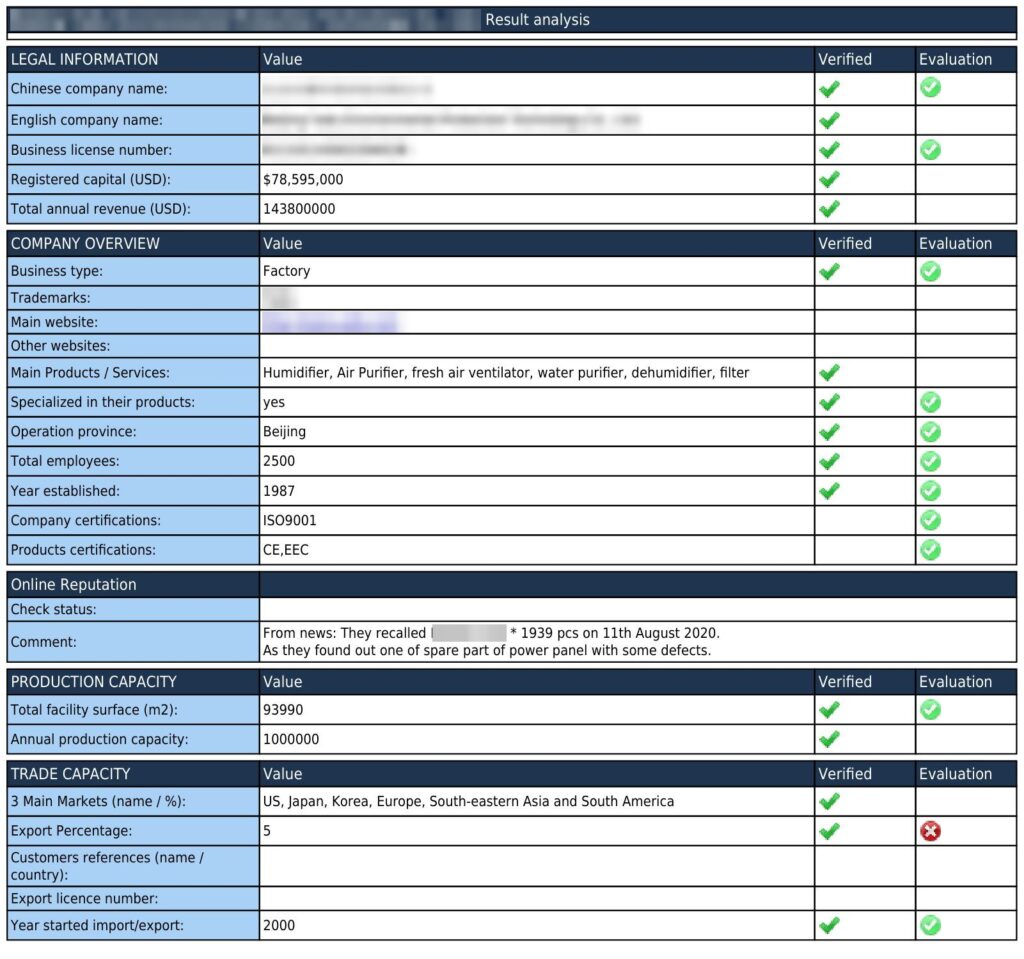
Each value is “verified” and then “evaluated”: a true figure can still be a weakness. In the example, a factory with a large capacity exported only 5% of its production: a point to weigh for a buyer selling in Europe.
How Asiaction runs a sourcing project
Our French-Chinese team in Guangzhou works as your purchasing office in China. A sourcing study has five phases:
- Needs analysis: your Asiaction contact studies the project and sets the sourcing strategy.
- Supplier search through our networks; catalogues, quotations and documents collected.
- Offer analysis against your requirements, including certificates and test reports.
- Company verification in the official Chinese database: registration, disputes, capacity, reputation.
- Delivery cost estimate: volume, weight, freight quotes, duties and taxes.
You receive every supplier’s contacts, certificates, quotations and official documents, and you can visit the factories. If you already have suppliers, we start with an investigation of those companies. Then we can follow the project through: factory audit, samples, order management, product inspection, loading supervision and shipping. We can also manage payments, so every payment to the factory goes through Asiaction. You follow production dates, inspection reports and documents in the online client portal.
The fastest projects start with a complete brief: product details, destination markets and their standards (see our product compliance guide), volumes, target price and key dates. Allow for Chinese New Year, when factories largely stop. For what comes next, read our guides on order management, quality control and importing from China.
FAQ: sourcing in China
Should I buy direct, through a trading company or through a sourcing agent?
Buy direct if you already have audited suppliers and people who speak Chinese and visit factories. A trading company can be honest, but you will not see who produces. For large, custom or recurring orders without a team in China, a purchasing office on site gives you factory prices, with checks and inspections done for you.
How do I choose a sourcing agent in China?
Check that it is a registered company with staff in China, ask for its track record and references, how it inspects and reports, and how it is paid. Avoid agents paid by suppliers, agents who hide the factory’s name and agents who ask for full payment before production.
Can Asiaction work with my existing suppliers?
Yes. We start with an investigation of the supplier (company verification and, if needed, a factory audit), then we can inspect production, manage orders and organise shipping.
What payment terms are usual with Chinese factories?
Usually 30 to 50% at order and the balance at the end of production, before loading. Tie the balance to a passed inspection and treat any request for full prepayment as a warning. When Asiaction manages your order, every payment to the factory goes through Asiaction.
Does Asiaction take commissions from suppliers?
No. Asiaction takes no commission from suppliers: its fee is paid by the client, never by the factory, so its only interest is yours. You receive the full contacts of every supplier we recommend and you can visit the factories.
What kind of orders does Asiaction handle?
We work with companies that place large orders, recurring orders or project orders: industrial firms, retailers, importers, brands and project companies. We do not handle small one-off purchases.
Need qualified factories for your next order or project?
Send us your product brief, volumes and target dates. Our team in Guangzhou will tell you how we would approach the sourcing and verification of your suppliers.