
In short
A pre-shipment inspection (or FRI, Final Random Inspection) is the check made in the factory before you pay the balance and before the goods leave China. The inspector checks a random sample, sized with the AQL tables of ISO 2859-1: quantities, workmanship, specifications, tests, labels and packing. Our default plan is Level II, zero critical defects, AQL 2.5 for major and AQL 4.0 for minor defects. Large or recurring orders also need a factory audit, loading supervision and, where regulations require it, lab tests.
This guide shows how pre-shipment inspection in China works at Asiaction: how we size the sample, classify defects, report and act when an order fails. It is written for companies placing large, recurring or project orders, and uses pages from real Asiaction inspection reports.
Why inspect before you pay the balance
On a full container or a project with a fixed opening date, a quality problem means blocked stock, returns or a missed deadline. Once the goods have left China, the balance is paid and your leverage is gone. Before shipment, the factory can still rework, sort or replace, and you can hold the balance until it is fixed. On recurring orders, the reports also build a quality history for each supplier.
It filters fraud too. In one client case, a routine pre-shipment inspection request on a steel order led our team to spot that the “supplier” was not the company it claimed to be. The client found out before paying the balance.
Which inspection, and when
Almost every order needs at least the pre-shipment inspection. Add other checks according to the risk, the order value and your history with the supplier.
| Inspection | When | What is checked | Worth it for |
|---|---|---|---|
| Pre-production (raw materials) | Before or at the start of mass production | Materials, components, colours, material certificates | New supplier or product, critical materials |
| During production (DUPRO) | Once part of the order is produced | First finished units, recurring defects | Long runs, custom products, tight deadlines |
| Pre-shipment (FRI / PSI) | Production finished, most goods packed | Quantities, workmanship, specs, tests, marking, packing (AQL sampling) | Almost every order, before paying the balance |
| Loading supervision | Loading day | Container, carton count, random cartons, seal | High-value goods, mixed containers |
| 100% sorting | After production or after a failed FRI | Every unit, defective units set aside | Safety-critical products, failed FRI |
| Laboratory testing | Before or during production | Chemicals, electrical safety, food contact, fire | When a regulation or customer requires proof |
Restricted substances or fire safety can only be proven by an accredited laboratory. See our product compliance guide for European importers.
Pre-shipment inspection in China: how AQL sampling works
Nearly every inspection in Chinese factories uses AQL (Acceptance Quality Limit) sampling, the method of ISO 2859-1 (the American ANSI/ASQ Z1.4 uses the same tables). It answers two questions: how many units to check, and how many defects you accept before rejecting the lot.
Why a sample, not every unit
Take 2,500 tablets that need 2 minutes of tests each. Checking every unit takes about 11 inspector-days. An AQL sample of 125 units takes one inspector one day. No factory will hold finished goods and workers for two weeks of checks, and you do not want to ship two weeks late. When a test destroys the product, a sample also limits waste.
The sample is not a fixed percentage either. It grows much more slowly than the order: at Level II, 1,000 units need a sample of 80, and 10,000 units need 200, not 800.
How to read the AQL tables in three steps
- Lot size + inspection level = code letter. The lot is the quantity of one product reference; different products are different lots. We use General Inspection Level II by default.
- Code letter = sample size. Letter K, for example, means 125 units.
- AQL per defect category = accept (Ac) and reject (Re) numbers. At Ac or below, the category passes. At Re or above, it fails. If one category fails, the lot fails.
Worked example: 2,500 tablets
2,500 units fall in the 1,201–3,200 range. At Level II, that gives code letter K and a random sample of 125 units. With our default plan:
- Critical defects, zero tolerance: accept 0, reject at 1.
- Major defects, AQL 2.5: accept up to 7, reject at 8.
- Minor defects, AQL 4.0: accept up to 10, reject at 11.
With 0 critical, 5 major and 12 minor defects, the lot passes on critical and major defects but fails on minor ones. The overall result is a fail.
Reference values (Level II, single sampling, normal inspection)
| Lot size | Code letter | Sample size | AQL 1.5 (Ac / Re) | AQL 2.5 (Ac / Re) | AQL 4.0 (Ac / Re) |
|---|---|---|---|---|---|
| 151–280 | G | 32 | 1 / 2 | 2 / 3 | 3 / 4 |
| 281–500 | H | 50 | 2 / 3 | 3 / 4 | 5 / 6 |
| 501–1,200 | J | 80 | 3 / 4 | 5 / 6 | 7 / 8 |
| 1,201–3,200 | K | 125 | 5 / 6 | 7 / 8 | 10 / 11 |
| 3,201–10,000 | L | 200 | 7 / 8 | 10 / 11 | 14 / 15 |
| 10,001–35,000 | M | 315 | 10 / 11 | 14 / 15 | 21 / 22 |
How to choose your AQL
- Start from our default: Level II, zero critical, AQL 2.5 major, AQL 4.0 minor. It suits most orders.
- Go stricter on demanding or high-value products: AQL 1.5 for major defects, as in the cold-cabinet report below.
- Change the level, not only the AQL: Level III gives a larger sample and more certainty, at a higher cost. Level I costs less but carries more risk.
- Keep tests apart: function, safety and destructive tests run on a small “special level” sample or on every unit, and are reported separately.
AQL covers visual and dimensional defects. It does not prove compliance, so judge an order on the whole report, not on the AQL line alone.
Critical, major and minor defects
- Critical: can harm the user or breaks a regulation. Examples: accessible live parts, sharp edges on a children’s product, missing mandatory safety marking, failed hi-pot test.
- Major: makes the product unsellable or likely to come back, without safety risk. Examples: torn seam, function not working, wrong colour, dimension out of tolerance.
- Minor: a small deviation, only unacceptable in large numbers. Examples: light scratch on a hidden surface, small dirt mark, slightly uneven stitching.
Position matters: a scratch on the back of a cabinet is minor, the same scratch on a glass door may be major. We write these rules into the inspection sheet with you, so everyone applies the same ones.
What we need from you before the inspection
Most disputes come from unclear requirements, not from the inspection itself. Our team in China builds the inspection sheet with you: check points, defect classes, AQL and tests. To do it, we need:
- Order documents: PO or proforma invoice, quantities per reference and colour.
- Specifications: spec sheets, drawings, bill of materials, tolerances, approved colours and finishes.
- A golden sample: a sealed, signed reference sample kept at the factory. Without it, appearance becomes a matter of opinion.
- Packing and labels: carton size and weight, shipping marks and carton numbers, barcodes, manuals, label language.
- Compliance marks: CE marking, rating plate content, certificates to check.
- Tests and expected results: function, assembly, electrical safety, load, carton drop.
The factory must also be ready: production finished, most goods packed (a common rule for an FRI is at least 80%), tools and staff available for tests. A factory that is not ready is the most common cause of a wasted inspection day.
How to read an Asiaction inspection report
You should be able to decide in five minutes. Here is how our final inspection reports are built, using our published samples.
1. Summary: six statuses
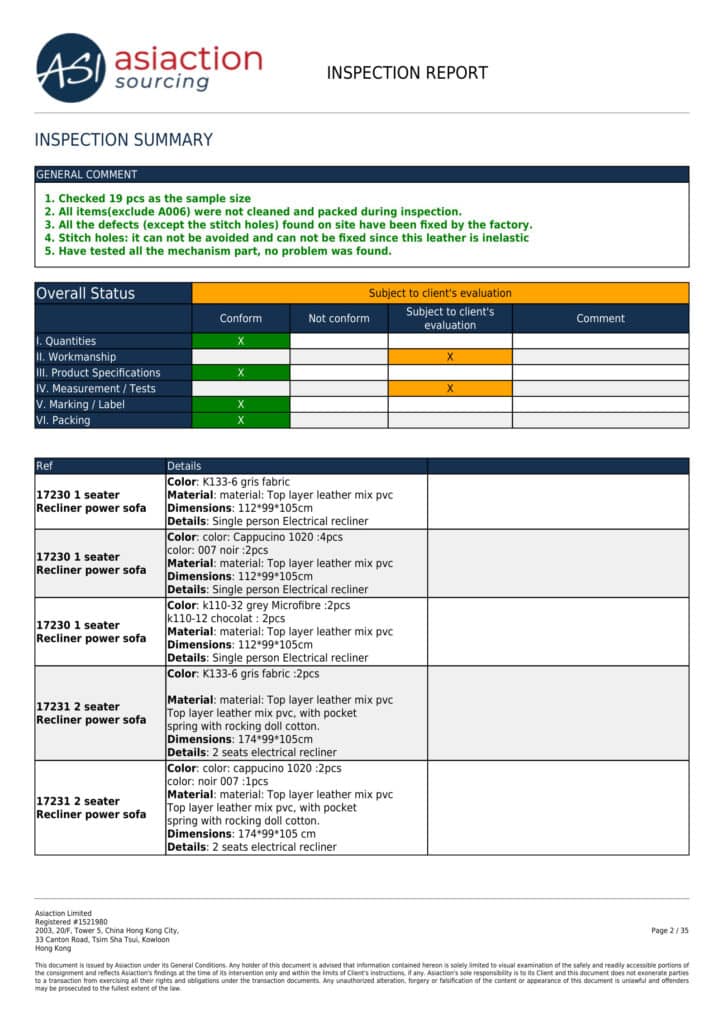
After the cover page, the summary gives a general comment and a status for six sections: Quantities, Workmanship, Product specifications, Measurement / Tests, Marking / Label and Packing. Each is Conform, Not conform or Subject to client’s evaluation: a point only you, the buyer, can decide. Quantities shows, per reference, what is packed, so you know if the order is really finished.
2. Workmanship and the AQL result
The report states the inspection level, sample size and AQL per category. Each defect is then listed with its class and a numbered photo. The “Total AQL Result” table shows passed or failed for each category.
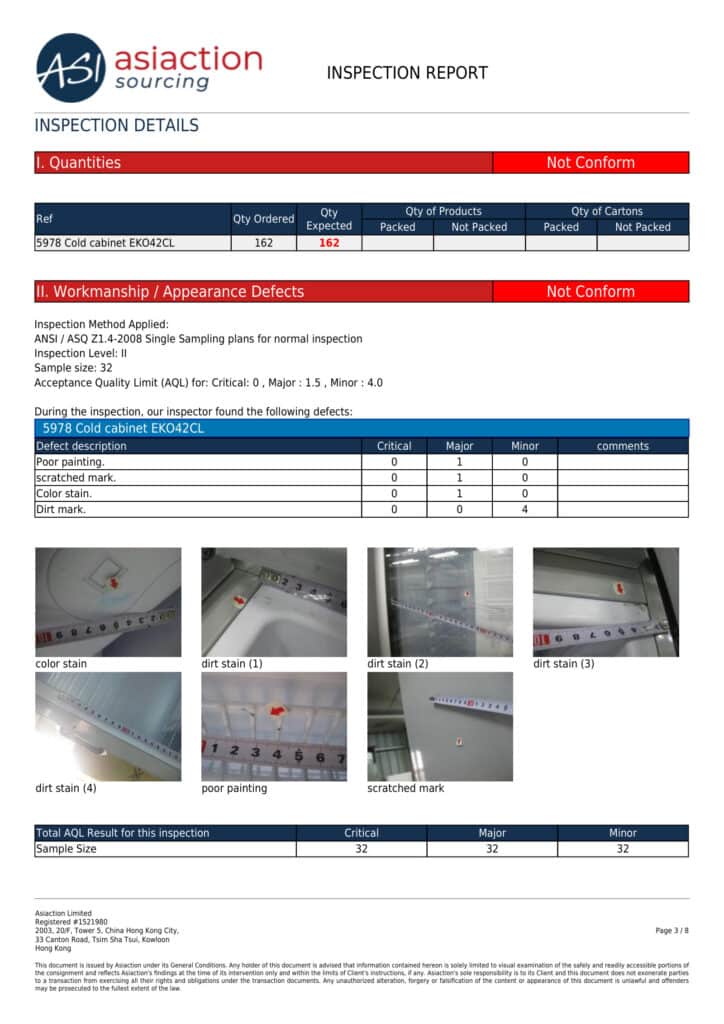
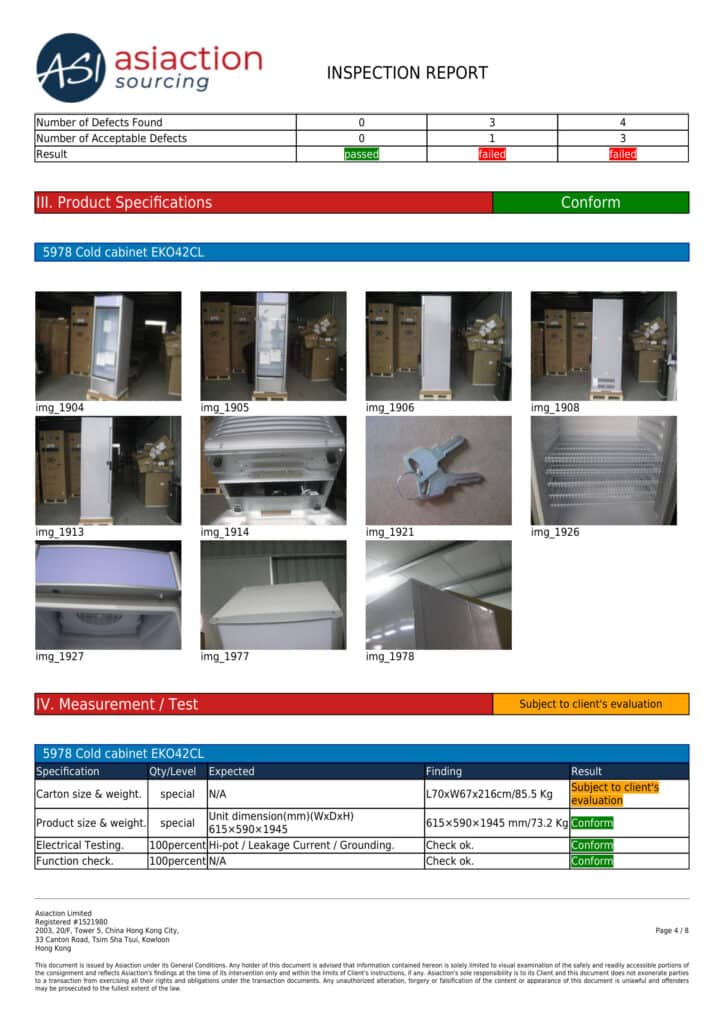
In this report, 162 cold cabinets gave a Level II sample of 32, with AQL 1.5 for major defects. The inspector found 3 major defects (poor painting, scratch, colour stain) against 1 accepted, and 4 minor defects against 3 accepted. Both categories failed. No critical defect was found.
3. Specifications, measurements and tests
The test table gives, for each check, the sample level, expected value, finding and result. For the cold cabinets: product and carton size and weight, electrical tests (hi-pot, leakage current, grounding) and function checks on 100% of units, power consumption and temperature. Other reports include carton drop, label rub, assembly or motor speed tests.
4. Marking, labels and packing
Do not skip these pages. In one report, the rating plate showed a motor speed and frequency different from the spec sheet, one motor rating was marked only in Chinese, and the shipping marks had no carton numbers. These are exactly the details that cause trouble at customs or with your customers.
What to check first
- The general comment: “defects fixed on site” or “factory refused some safety tests”. A refusal is a finding in itself.
- The sample actually inspected: if the factory limited it, the AQL result means less.
- Every “Subject to client’s evaluation” line: for example a dimension a few centimetres off the drawing.
When an inspection fails
A fail is useful news: the goods are still in the factory and the balance is unpaid. After a failed report, our team helps you settle it with the supplier. The options are:
- Rework: the factory fixes the defects, sometimes during the inspection itself, as in two of our sample reports.
- Re-inspection: confirms the result after rework. Agree in your contract who pays for it.
- 100% sorting: every unit is checked, defective ones removed or replaced.
- Discount: negotiated with the factory, or partial acceptance of the order.
- Refusal of all or part of the order: often the only option for critical defects or regulatory non-compliance.
A real example, on a 2024 solar module order: the combined factory audit and final inspection failed on the bill of materials (components not as agreed) and on the drawing (one frame side measured 6 mm instead of 10.7 mm). The factory corrected both. We re-checked these points on two later visits until they passed.
Before and after the inspection: audit and loading
Factory audit, when you choose the supplier. A factory audit answers “Can this supplier make my product reliably?” It reviews legal documents, premises, production lines and quality processes. An inspection answers a different question: “Is this order conform?” A good factory can still produce a bad batch, so large programmes need both.
Loading supervision, on loading day. A passed inspection does not guarantee the right goods go into the container. The inspector checks the empty container, counts cartons against the packing list, opens random cartons and photographs the seal. In our sample loading report, the inspector also flagged unused space in the container. If something is wrong, loading can be stopped.
How Asiaction runs your inspections
Asiaction is a French-managed purchasing office in China. We have worked in sourcing and manufacturing in China since 2008, from our operating office in Guangzhou, with more than 3,200 projects and 6,500 partner factories. Our product inspection service works in four steps:
- Preparation: we build a clear inspection sheet with you (check points, defect classes, inspection level, AQL and tests). You can add your own control points.
- Inspection: at the stage you choose (raw materials, during production, final, loading), with ISO 2859-1 sampling, measurements and functional tests. When needed, we organise accredited laboratory tests with partner laboratories such as SGS, Intertek or Bureau Veritas.
- Report: HD photos and videos, figures, test results and comments, typically sent the same day. Urgent issues are flagged during or right after the visit. A project manager, a quality manager and the inspector work on each project and stay available to explain the report.
- Follow-up: after a fail, we help you negotiate with the factory for rework, a discount or the refusal of all or part of the order.
Clients find their reports, production dates and import documents on our online client portal. Inspections can be booked alone or within our order management and shipping management services. See how one inspection grew into a long-term programme in our furniture retailer case study, or read our guide to importing from China.
FAQ
What is the difference between a pre-shipment inspection and an FRI?
None in practice. Both describe the AQL check of finished, mostly packed goods before the balance is paid.
Which AQL should I use?
Our inspectors’ default is General Inspection Level II, zero critical defects, AQL 2.5 for major and AQL 4.0 for minor defects. For demanding or high-value products, use AQL 1.5 for major defects.
How many units are checked for an order of 10,000 pieces?
For 3,201 to 10,000 units at Level II, ISO 2859-1 gives code letter L and a sample of 200. At AQL 2.5 the lot is accepted with up to 10 defects and rejected at 11; at AQL 4.0, accepted up to 14 and rejected at 15.
Why not inspect 100% of the order?
It takes too long and costs too much: for 2,500 units at 2 minutes each, about 11 inspector-days instead of one. Keep 100% checks for safety-critical products or for sorting after a failed inspection.
Does a passed AQL inspection mean my products are compliant?
No. AQL sampling checks visible and measurable defects. Regulatory compliance (chemicals, electrical safety, food contact, fire safety) must be proven with documents and often with accredited laboratory tests.
When will I receive the inspection report?
Asiaction reports, with HD photos and videos, are typically sent the same day as the inspection. Urgent issues are flagged during or right after the visit.
Plan the quality control of your next orders
Tell us about your products, volumes and suppliers. Our team in Guangzhou will propose an inspection plan (stages, AQL, tests) adapted to your orders.