Source Air Conditioners from China — Your European Partner for Residential AC Supply
Split, multi-split, portable, inverter and heat-pump units — sourced from verified Chinese factories, checked for EU compliance, inspected before shipping, and delivered to your door. One accountable partner, on the ground in China since 2008.
★ 4.7 / 5 on TrustpilotIn China since 2008French & European team in GuangzhouEU Chamber of Commerce member
Why importers and distributors source air conditioning from China
The world's AC factory floor: scale, price and technology
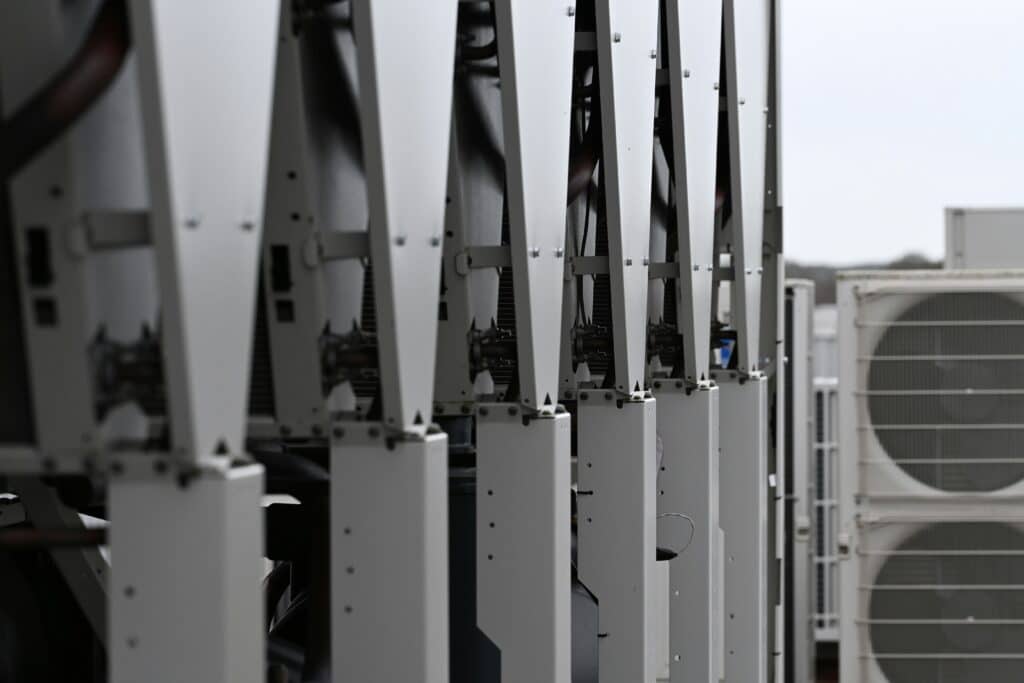
No country comes close to China’s air-conditioning capacity. Domestic output now exceeds 200 million units a year, with manufacturing capacity above 300 million, and close to half of everything built is exported. The “Big Three” — Gree, Midea and Haier — hold roughly 70% of the domestic market between them, with strong challengers such as TCL, Hisense, AUX, Chigo and a fast-rising Xiaomi behind them. Beneath the brands sits an enormous base of OEM and ODM factories in Guangdong, Zhejiang and Ningbo that build private-label units for importers all over the world.
For a European buyer, that concentration is a gift: inverter technology that used to be premium is now standard, component supply (compressors, PCBs, coils) is deep and competitive, and you can specify almost anything — capacity, refrigerant, voltage, colour, controls and your own brand on the box.
Where the opportunity — and the risk — lies for European buyers
The opportunity is obvious in your margin. The risk is less visible. A container of units can arrive with the wrong refrigerant for your market, a photoshopped CE certificate, an inverter board that fails in its second season, or gas leaks from flare joints that shook loose in transit. Worse, you may have wired a deposit to a trading company that never touched a production line. None of this shows up in a glossy marketplace listing. It shows up when the goods land — when it is your problem, not the factory’s.
Asiaction in one line
Asiaction is a European-run sourcing company that has operated inside China since 2008, with a French-managed office in Guangzhou staffed to deal with factories in native Chinese. We are a member of the European Union Chamber of Commerce in China, bank with HSBC, PayPal and Wise, and hold a 4.7 / 5 “Excellent” rating on Trustpilot. We don’t own a factory and take no hidden commission from suppliers — which means we answer to you, not to them. For air conditioning, that translates into one thing: you get the price and choice of China with the accountability and standards of Europe.
Every residential AC system we can source for you
China builds essentially every residential AC form factor in the world. Below is the range we source most often for importers and distributors, with the capacity bands and the things that actually matter when you buy at volume.
Split systems & wall-mounted units
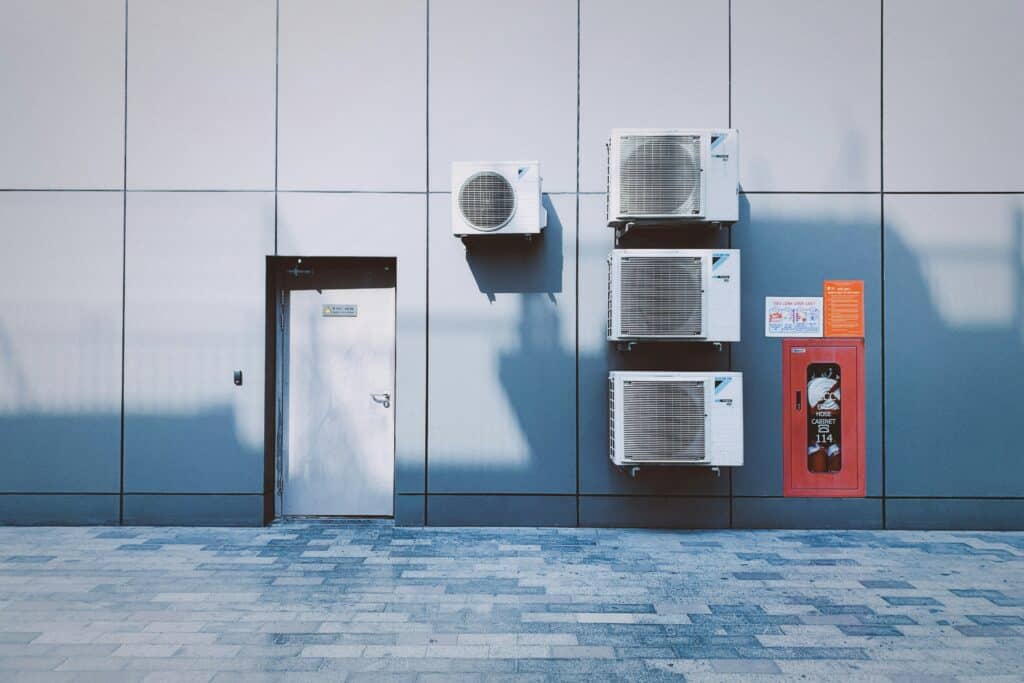
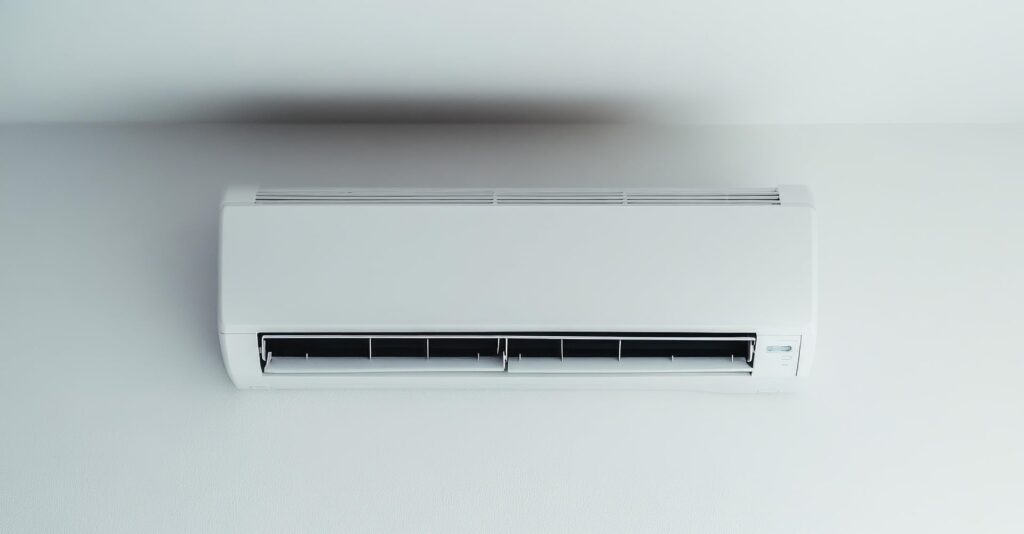
The global workhorse: one outdoor condensing unit (ODU) paired with a wall-mounted indoor unit (IDU), connected by refrigerant lines. Typical capacities run 9,000–24,000 BTU/h (about 2.6–7.0 kW), clustering at 9k, 12k, 18k and 24k, with large-room versions to ~36k. This is the core commodity — but the refrigerant is factory-sealed inside, so the refrigerant choice (R-32 vs R-410A) quietly decides whether the unit is even legal to sell in your market.
Multi-split & mini-split (ductless) systems
A mini-split is simply the North-American name for a ductless wall split — same machine, different vocabulary — and it drives a huge retrofit and aftermarket. A multi-split connects one larger outdoor unit to two to five indoor heads (wall, cassette or floor), ideal for conditioning several rooms of an apartment or house from a single ODU. Multi-splits carry higher value and margin but need careful specification of indoor-unit combinations, pipe lengths and branch kits.
Portable / mobile and window air conditioners
Portable units are free-standing floor boxes on castors that vent hot air through a window hose, typically 8,000–14,000 BTU/h — the cheapest, lowest-efficiency, highest-return category, and often charged with flammable R-290 (propane), which affects shipping. Window units are self-contained chassis, big in the US, Middle East and India, from 5,000 BTU/h upward. Both are high-volume retail products where packaging and functional testing matter enormously.
Cassette & floor-standing units
Ceiling cassettes recess into a false ceiling and blow from one to four sides — popular for shops, offices and open-plan villas, usually 12,000–48,000 BTU/h. Floor-standing “cabinet” units are a Chinese-market staple for living rooms and retail spaces; verify the aesthetics and controls suit your market, since the domestic styling is not always right for European buyers.
Inverter units — the efficiency standard
Inverter compressors modulate their speed instead of cycling on and off, delivering quieter operation, tighter temperature control and far better efficiency. They are now effectively required to meet EU, US and Chinese efficiency minimums, so fixed-speed units survive only in low-cost markets. The one caution: the quality of the inverter board (the PCB / IPM module) is a genuine differentiator and a common failure point — always ask which drive and compressor a factory uses.
Air-to-air heat pumps and reversible AC
Almost every modern split is a reverse-cycle heat pump: a four-way valve lets the same unit cool in summer and heat in winter. This is a specification choice, not a different machine, but it changes the ratings you must quote (SCOP/HSPF for heating) and even the customs code. If you are moving toward heating products, note that air-to-water heat pumps — which heat water for radiators or underfloor systems — are a separate category with their own certifications, and should be treated as a distinct line rather than an add-on.
At a glance: AC type, typical use and what to watch
| System type | Typical use | Typical capacity | What to watch |
|---|---|---|---|
| Wall-mounted split | Single room, volume workhorse | 9,000–24,000 BTU/h | Refrigerant decides legality |
| Mini-split (ductless) | Retrofit, zoned comfort | 9,000–36,000 BTU/h | Ratings & listings by market |
| Multi-split | Several rooms, one ODU | 18,000–48,000 BTU/h | IDU mix & pipe runs |
| Portable / mobile | Renters, spot cooling | 8,000–14,000 BTU/h | R-290 shipping, return rates |
| Window | Single room, US / ME / India | 5,000–24,000 BTU/h | Voltage 115V vs 230V |
| Cassette | Shops, offices, villas | 12,000–48,000 BTU/h | Ceiling void & drain pump |
| Floor-standing console | Living rooms, retail | 18,000–60,000 BTU/h | Styling for your market |
Selling AC in Europe: the compliance you cannot skip
CE marking and product safety
CE marking is a mandatory self-declaration backed by a real technical file, covering the applicable safety and EMC rules. Beware a critical trap: CCC (China Compulsory Certification) is for selling inside China and is not a valid EU credential. A factory that waves a CCC certificate — or a “self-declared” CE with no supporting test report — has given you nothing you can rely on. The relevant safety standards here are EN 60335-1 and EN 60335-2-40 (which now include provisions for mildly flammable A2L refrigerants).
The F-Gas Regulation and the R-410A to R-32 transition
This is the fastest-moving and most consequential rule in the category. The EU F-Gas Regulation (EU) 2024/573 is progressively banning high-GWP refrigerants: small single-split systems using R-410A are already restricted, which is why new export production has largely shifted to R-32 (GWP ~675) in place of R-410A (GWP ~2,088). Further tightening later this decade will eventually reach even R-32 in small splits. The practical consequence for you: an R-410A unit may be cheaper to buy today and still be unsellable as new stock in Europe. Refrigerant must be specified to your market’s law and timeline — not just to price.
Energy labelling and EPREL registration
Air conditioners sold in the EU need a mandatory energy label and must be registered in the EPREL product database, and they must clear the Ecodesign/ErP minimum efficiency thresholds. A unit that falls below the minimum, or that ships without a valid label and EPREL entry, cannot legally be placed on the market — regardless of how good the price looked.
RoHS, WEEE, packaging and duty
RoHS restricts hazardous substances in the electronics; WEEE obliges you to register for and fund electronic-waste take-back in your market. Air conditioners are classified under customs heading HS 8415, with the sub-code depending on whether the unit is a reversible heat pump or cooling-only and self-contained or split — the correct classification affects your duty rate and your paperwork.
How Asiaction builds compliance into the order — not after it
We treat compliance as a specification, agreed with the factory before production, and then verified. That means confirming the refrigerant and charge weight in writing, collecting the model-specific test reports and technical file (not a logo), checking CE and energy-label documentation against the issuing databases, and confirming the unit’s efficiency actually meets your market’s minimum. Our inspection and quality-control teams then verify labelling and documentation on the real production units, so what ships is what you can legally sell.
How Asiaction sources your air conditioners — step by step
Every AC program we run follows the same five-stage chain, from finding the right factory to landing the container. You get one dedicated, bilingual project manager across all of it, and full visibility through our online client portal.
Sourcing verified manufacturers (not trading companies)
We start from your exact spec — unit type, capacity range, refrigerant, destination voltage (230V EU vs 115V and others), certifications, target price and MOQ — and run a structured five-step search: needs analysis, prospection, offer analysis, company evaluation and delivery-cost estimate. You receive compared quotes from real factories, with verified documents rather than potentially falsified ones. Explore our full China sourcing service.
Supplier verification & factory audits
This is the anti-scam stage. A trading company can email you a rented showroom and a borrowed certificate; only an on-site audit confirms the assembly line, testing benches and refrigerant-charging stations actually exist. Our supplier verification and factory audits come in three tiers — a Company Check-Up from $99 (24h, cross-referenced against official Chinese registries), a deeper Company Investigation ($349), and a full on-site Factory Audit ($595) with photos and video.
Sampling, private label & OEM customisation
We lock a signed golden sample and bill of materials before mass production, so there is an agreed reference to inspect against. This is also where private-label and OEM details are fixed: branding, packaging, colour, controls, WiFi app and firmware ownership, and any custom tooling.
Production monitoring & pre-shipment quality inspection
Our inspectors work to the ISO 2859-1 / AQL standard across pre-production, during-production and pre-shipment stages ($349 per man-day), with same-day reports carrying HD photos and video. For AC specifically, that means catching the failures importers fear most before the container is sealed: compressors that won’t start, refrigerant undercharge or leaks, wrong voltage or plug type, missing energy labels and packaging too weak to protect coils in transit. See our product inspection & quality control.
Order management, consolidation & EU-bound shipping
A dedicated French/Chinese project manager owns the order, speaks to the factory in Chinese, and drafts bilingual (Chinese/English) purchase contracts — real recourse that a proforma invoice can’t give you. Then our shipping team handles logistics: because AC units contain refrigerant, they can ship as regulated dangerous goods, and getting the UN classification and declarations right is what stands between a smooth clearance and a seized container. Track everything from departure to arrival in the portal. Related: order management.
Private label & OEM air conditioners for distributors
If you distribute under your own brand, China’s OEM/ODM base is your biggest advantage — a very large share of exported units are private-label rather than Chinese-branded. There are two routes: ODM, where you rebrand a factory’s existing, proven design (faster and cheaper), and OEM, where the factory builds to your own design and specification (more control, higher MOQ).
Branding, packaging and spec customisation
We help you customise the elements that matter to a distributor: brand and logo, colour and finish, remote and control layout, the WiFi app and its data hosting, retail packaging and manuals in your languages, and the certification set for your target markets. The WiFi module itself needs its own radio approval (CE/UKCA or FCC), which we confirm rather than assume.
Protecting your brand: contracts and verification
Private label only pays off if the design stays yours and the quality holds. Bilingual contracts, verified suppliers and a locked golden sample protect you against a factory quietly cheapening the build or selling your design on. This is where an accountable partner is worth far more than the fee.
The real numbers: MOQ, lead times and the buying calendar
Typical MOQs by product type
Lead times and the European buying calendar
Standard OEM/ODM production typically takes about 4–8 weeks after deposit and approved sample; fully custom designs run 8–12 weeks or more. Then add sea-freight time to Europe. The decisive factor is seasonality: Chinese AC production ramps hard from February to June ahead of the northern-hemisphere summer, with capacity tightest in March–June, and a two-to-four-week shutdown around Chinese New Year. Best practice is to place orders in autumn or winter (roughly October to January) for delivery before summer. A heatwave that spikes demand can tighten supply and lead times sharply — planning ahead is the cheapest insurance you can buy.
Container loading and landed cost
Air conditioners are bulky, so cost per unit landed is driven as much by cubic metres as by the factory price. How many units fit a 40-foot high-cube depends heavily on capacity and carton size — small portables pack in by the many hundreds, large split sets far fewer. We calculate the exact CBM and container plan per model, and advise on Incoterms (EXW vs FOB) so the quote you compare is the true landed cost, not just the ex-works price.
Sourcing agent vs. Alibaba vs. going direct — an honest comparison
| Buy direct on a marketplace | Random freelance agent | Asiaction | |
|---|---|---|---|
| Factory is verified | You hope so | Sometimes | Registry check + on-site audit |
| Compliance handled | Your problem | Rarely | Built into the spec & verified |
| Quality inspected | No | Varies | AQL / ISO 2859-1, HD photo + video |
| Contract & recourse | Proforma only | Weak | Bilingual enforceable contract |
| Accountable entity | None | An account | EU company since 2008, 4.7★ |
| Independence | — | Often takes supplier commission | No hidden commission, no supplier bias |
Direct is only cheaper if nothing goes wrong. One container of dead-on-arrival or leaking units, one deposit to a vanished trading company, or one shipment seized at customs can erase years of the fee you saved. What you buy from us is the absence of a five-figure mistake — and you keep the factory relationship, because we hand over the full contact details of every supplier we identify.
Why importers trust Asiaction as their China supply-chain partner
The real reason importing from China feels risky is distance: a country whose language, legal system and factory landscape you can’t read, with your capital already wired. Asiaction closes that distance. You don’t get a vendor in China — you get a French-run team that lives inside China and works only for you. That single fact answers the four fears every importer has: getting scammed (we verify the factory before you pay a deposit), quality failures you only discover on arrival (we inspect and show you HD photo and video before the goods leave), a communication black hole (one bilingual manager, native-Chinese factory contact, portal updates at every stage) and no recourse when it goes wrong (enforceable bilingual contracts and post-delivery defect resolution).
Behind the promise sits a real, banked, reviewed company: founded in 2008, a member of the European Union Chamber of Commerce in China, banking with HSBC, PayPal and Wise, named directors on two continents, and clients including EPTA, GL Events, Transdev, Multiplast and UEFA Euro 2016. And our independence is structural — no hidden commissions and no dependence on suppliers, so our incentive is your protection, not a kickback.
What our clients say
Frequently asked questions
What types of air conditioners can I import from China?
You can source the full residential range: wall-mounted split systems, multi-split and mini-split (ductless) systems, portable and window units, ceiling cassettes, floor-standing consoles, and reverse-cycle heat pumps. Almost all are available as energy-efficient inverter models.
What is the minimum order quantity (MOQ) for air conditioners from China?
MOQs are factory-specific. Ready ODM stock models can start around 100 units, while a fully custom OEM run with your own branding, tooling or firmware usually requires container-scale volumes of roughly 1,000 units or more. Asiaction negotiates and confirms the real MOQ per supplier.
Are Chinese air conditioners CE certified and legal to sell in the EU?
Chinese factories can produce fully EU-compliant units, but CCC is not a valid EU credential. Legal EU sale requires genuine CE marking, Ecodesign/ErP efficiency, an EU energy label with EPREL registration, RoHS and WEEE compliance, plus an F-Gas-compliant refrigerant. Asiaction verifies these at source.
What refrigerant do Chinese AC units use, and is it EU F-Gas compliant?
Most new Chinese export splits use R-32 (GWP ~675), which replaced the higher-GWP R-410A (GWP ~2,088). Under the EU F-Gas Regulation 2024/573, small R-410A splits are already restricted, so specifying the correct refrigerant for your market and timeline is essential. Asiaction maps refrigerant choice to current EU rules.
Do I need an energy label and EPREL registration to sell AC units in Europe?
Yes. Air conditioners sold in the EU require a mandatory energy label and registration in the EPREL product database, and they must meet Ecodesign/ErP minimum efficiency. Units below the minimum, or without a valid label and EPREL entry, cannot legally be placed on the EU market.
How long does production and delivery from China to Europe take?
Standard OEM/ODM production typically takes about 4 to 8 weeks after the deposit and approved sample, and fully custom designs 8 to 12 weeks or more. Sea freight to Europe then adds several weeks. Because AC production peaks before summer, ordering in autumn or winter is strongly advised.
Can Asiaction produce private-label or OEM air conditioners for my brand?
Yes. We source both ODM stock models you can rebrand and full OEM production built to your specification, with custom branding, packaging, colour, controls and app — protected by bilingual contracts and supplier verification.
Start sourcing your air conditioners from China today
Tell us the units you want to sell and the markets you serve. We’ll come back with verified factories, a compliance and QC plan, and a true landed-cost quote — with no commission and no supplier bias.
Learn more about Asiaction and our team in China since 2008.